
TL;DR: “Sam’s UX Story” highlights the development of SAM, an AI system focused on accessible knowledge. It emphasizes collaboration, empathy, and user-centered design in advancing AI technologies and scaling knowledge-based systems.
THE BIRTH OF SAM
The idea of an intelligent assistent with human like characteristics has been a scifi topic for generations. The idea of Artifical General Intellegence (AGI) as a business product was conceived by the designer of SAM’s user interface.
HUGH DUBBERLY

THE KNOWLEDGE NAVIGATOR
SAM’s story starts back in 1987 when Hugh Dubberly created the video Knowledge Navigator for Apple’s CEO Sculley. (Find it here.) The video shows a device that can access a large networked database of hypertext information, and use software agents to assist searching for information. This vision was the first glimpse of the semantic AI model.
Hugh was the head of Apple Creative Services when he wrote and created the Knowledge Navigator video for John Sculley, Apple CEO. That video predicted many of the internet features we know today including SIRI and iPhones. The semantic AI model used to guide AICYC can be traced back to Hugh’s vision.
The Dubberly Design Office (DDO) designed SAM’s user experience (UX) that is central to AICYC. Hugh worked with the DeepMeaning AI team to create seamless access to knowledge using the knowledge graph data built into SAM. A demo of Hugh’s navigation system for SAM can be found here.
Then as now the general view in AI is that scaling knowledge-based systems to reason across knowledge domains like the Knowledge Navigator does is unlikely, impossible or far in the future. The AICYC creators think the time is now.
PATENTS
In 1997, the foundation of the world wide web, Web 1.0., was coded by Berners-Lee. That same year the Intellisophic founders (Burch, Hoey, Kon) set out to create SAM by automating knowledge mining. Burch and Kon filed for a patent on the Orthogonal Corpus Indexing (OCI) process we invented. The patent was granted in 2010. Read about OCI here. Burch and Kon have been granted many other patents related to OCI.
That year Intellisophic ran a test of the OCI concept using the World Book Encyclopedia as the published source.
Within 3 months the traffic reached 3 million a day. There were 100 million users on the internet then. The computational and machine cost was prohibitive so the public version was discontinued.
THE BAR COASTER
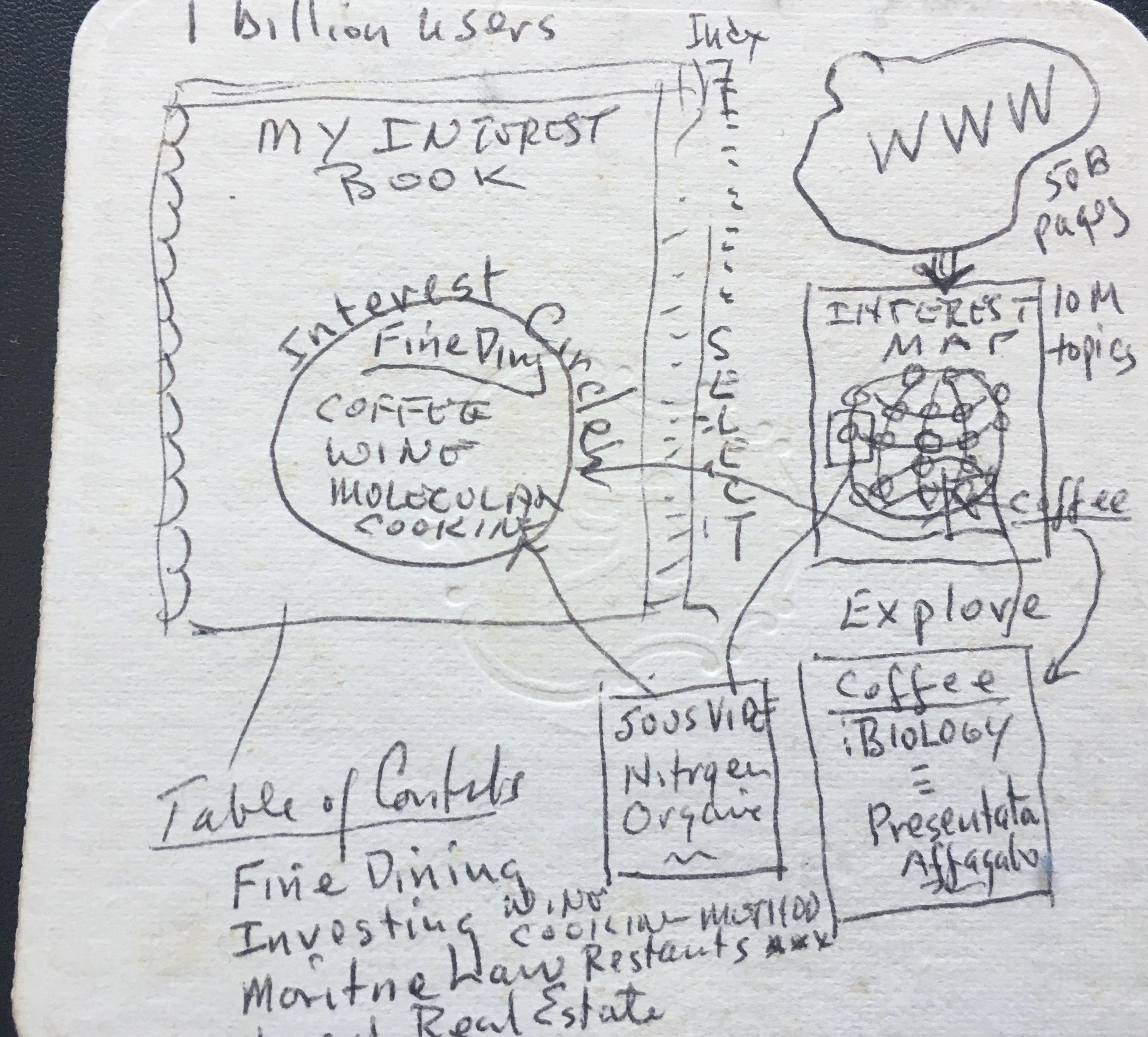
SAM was conceived as a social network based on shared interets in 2011 on a bar coaster. The most important part is the vision of 1 billion users is part aspiration and part possibility. One of the ways to create virule adoption was social networking as show in the original design. “My Interest Book” is visualized as a place users of AICYC can save articles and share interests. Groups can form or coalesce around a topic and collaborate in “Our Interest Book”. I can connect my interest book to your interest book and learn from each other. Visualize AICYC as a social network for sharing interests, and as a global meeting place, or even a match.com for minds. This video explores a meeting in a coffee house and a newbie’s frustration without current search. Sharing clean knowledge is as important as keeping knowledge clean.
. A Facebook it isn’t
KNOWLEDGE SOURCES
By 2014 The DeepMeaningAI code stack was ready to index the world’s reference libraries. The knowledge corpora needed were reference books, manuals, and encyclopedias. Most were open sourced licensed like Wikipedia and PubMed. However the most respected and vetted books were privately published. To provide SAM with the most authoritative source material we obtained the legal rights to use copyrighted works to add to SAM’s knowledge graph.
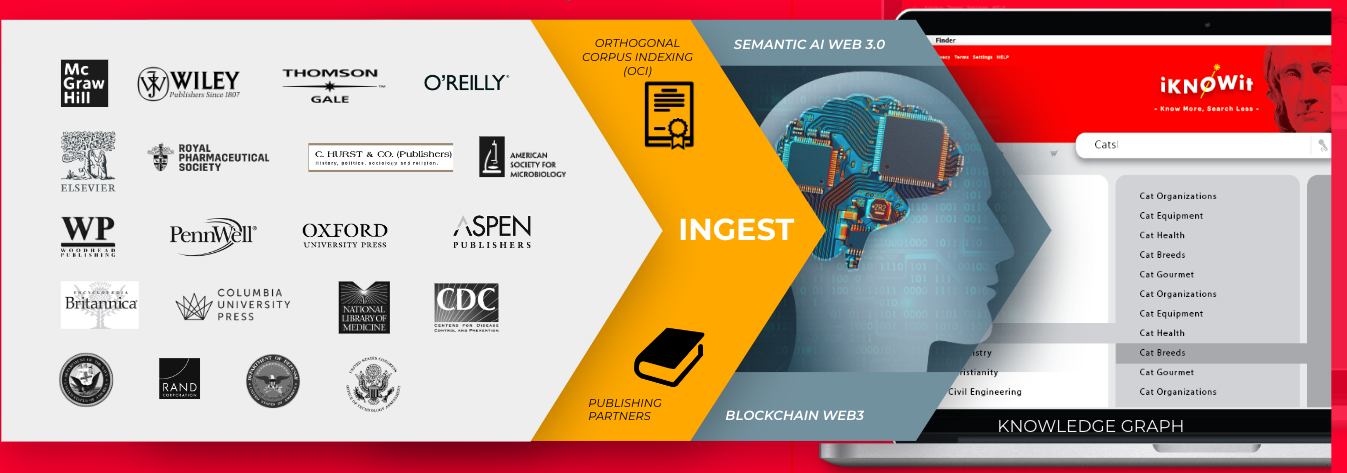
Currently over 80% of reference corpora publications in English have licensed taxonomy rights to Intellisophic for building the DeepMeaning data base. Currently SAM has ingested thousands of reference books from respected publishers like Gale, Britannica, Elsevier, O’Reilly, McGraw-Hill, and John Wiley. For example a selection of Elsevier Health reference works looks like this
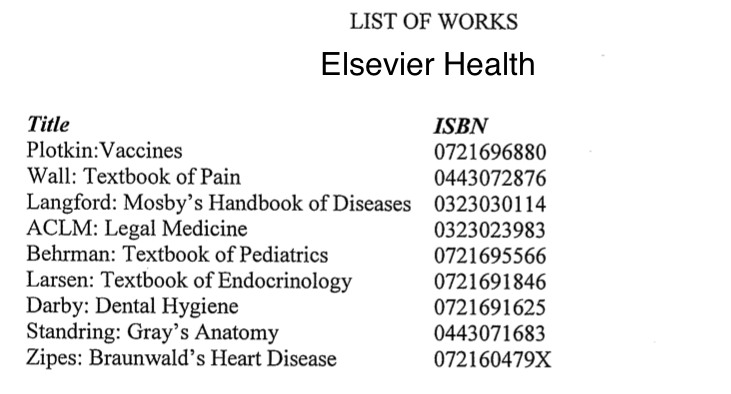
SAM reads these works and extracts the taxonomy, illustrations and facts. One example is Grays Anatomy. It is one of the most respected sources of knowledge about anatomy.
SAM’s knowledge graph is updated when new editions become available. This process provides AICYC with the most current knowledge foundation to guide LLM.
USER EXPERIENCE (UX)
We knew that human interaction with a large knowledge graph needed a compelling and simple user experience. The DeepMining AI team partnered with Hugh and the Dubberly Design Office in San Francisco to design the SAM user interface.
There are two ways knowledge is navigated in the SAM desktop interface. The mobil experience (MUX) is described below.
SEARCH
The user enters keywords into a search box to find topics of interest for LLM to write. The results is a list of AICYC articles not individual website links.
In this example typing the interest cue “Hockey” results in a list of AICYC articles with pictures that distinguish each topic. Each topic has a context path to disambiguate the cue words. The second case with interest cue “Leather Jewlery” shows the default experience is keyword search when SAM has no direct trusted article to offer..
GLOBAL EXPLORATION
One thing missing on the internet is the ability to easily and pleasantly explore the vast content of the world wide web. This human experience is called browsing. Browsing is a crucial component of information discovery; it allows an information seeker to expand organically upon a vague, often unarticulated need. Search users can not browse topics. The links they get are not organized.
The user in this example is browsing SAM’s knowledge graph from a global perspective seeking to know more about cat breeds.
LOCAL EXPLORATION
When users choose a specific interest using search or global explore their knowledge journey just begins. Across the topic page is a knowledge hub that provides local exploration of topics close to the original interest. In this case “Studded bracelets” is one of many topics under “Punk fashion.” The knowledge hub is like a tutor that shows how topics connect and provides other encyclopedia articles by selecting another topic. Articles that explore Punk music and the relationship to fashion can be found on a parent pulldown list. As you see in the video the knowledge hub enables understanding by just a touch. The red circle in the pull down menu shows that the initial interest it is just 1 of 18 concepts needed to know more about Punk.
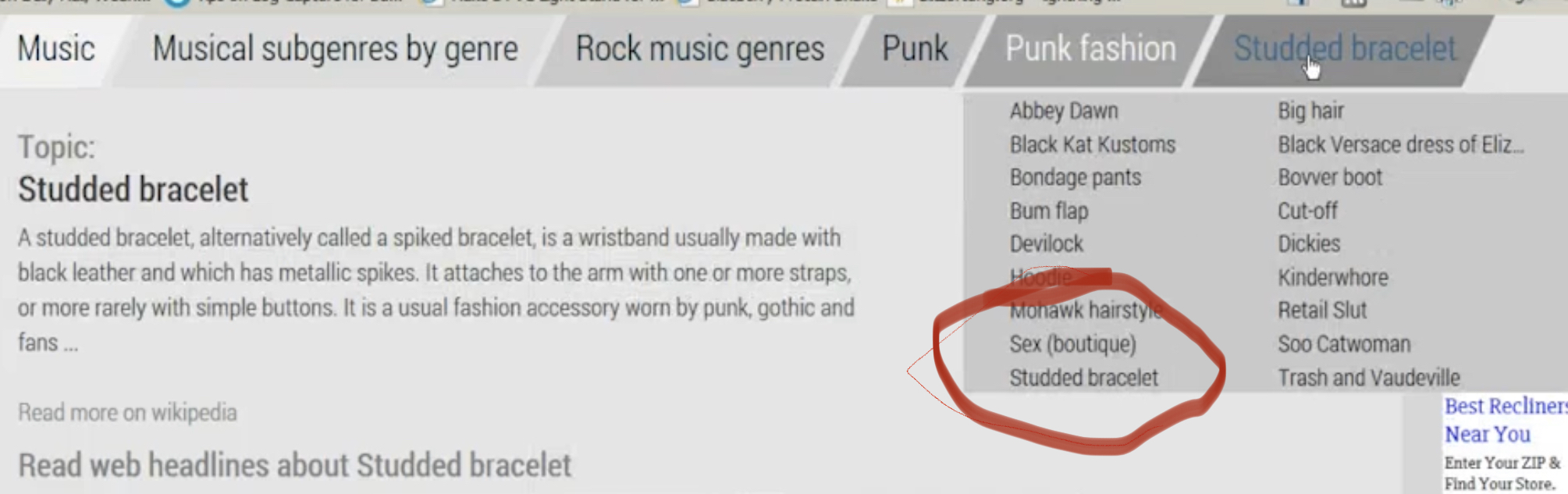
This example shows how AICYC overcomes knowledge gaps and makes it possible to move outside knowledge bubbles for everyone. Understanding topics is built into the knowledge hub.
The DDO design has been stable as SAM’s knowledge graph has grown from a few thousand topics to many millions today.
MOBILE UX
ROBERT FAUGHT

MOBILE DESIGN MASTER
Mobile is the most common mode for information delivery on the internet. Our MUX designer Robert Faught appears in SAM’s story in his role as a master of mobile design. This screen shot shows the layout of the knowledge hub on a mobile device. Rob completed graduate studies at MIT’s Visible Language Workshop (later a part of the MIT Media Lab headed by Nicholas Negraponte.)
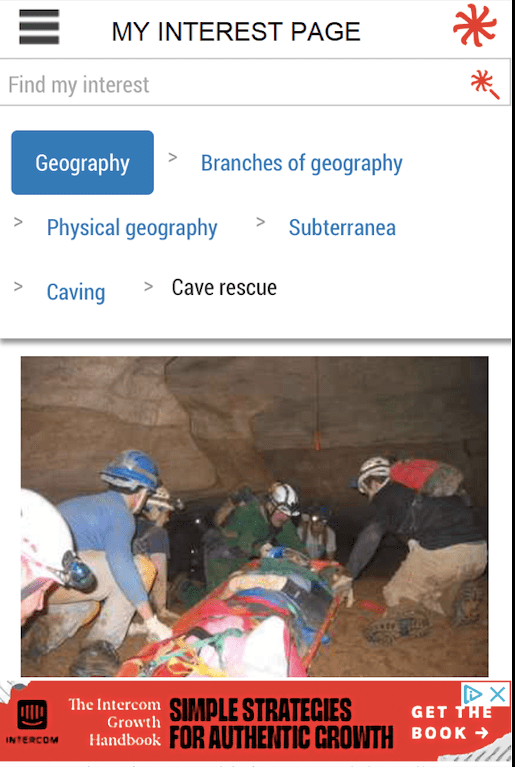
Specific LLM articles generated for users based on SAM prompts in the Sphynx Cat examples can be found here.
USER ENGAGEMENT
Over five million page views from thousands of visits provided the user experience navigating the UX data. This reflects the use of AICYC as shown in the previous video demonstrations.
USER EXPERIENCE DATA

The user engagement for the device types shown were tracked by Google Analytics.
Bounce and page views measure stickiness of a website. Page views is an estimate of the number of LLM articles the average visitor will equest on a visit. The user efficency is very high as seen in the duration data. The mobil user is finding information at 3 topics per minute which is double that of the other device types. The experience shown here is nearly 5X improvement over the average content website.
The experience shows a very high out-of-box performance for AICYC navigation in general but especially in the MUX design for mobil. This finding is very encouraging since adoption on mobil is required to reach most users on the internet.
THE BEGINNING
SAM’s story is just beginning. Semantic AI provides the intelligence needed to begin a new age of safe knowledge exploration.

