
The seemingly mundane topic “SYSLOG” was purposfully used to focus on the process not the topic. It was meant to be uninteresting for all but a few technicians. But never before has an article been written with no human intelligence involved. Even the LLM chatverse assumes humans write prompts and have to read and check what the LLM writes. In AICYC the understandng is automated using SAM. From a process view the article generated by LLM is called when the user navigates to the topic. References and fact checking occur while the page is loaded. The article is saved and added to all topics mentioned (one article may appear in multiple topics. Here is the generic prompt: “Write an encyclopedia article on the topic ‘Syslog’ Use the following Knowledge Graph data structure from AICYC” What SAM sent to chatGPT was knowledge graph (KG) data. The data is the prompt and LLM understood the generic instructions above. The KG data for every topic is in three parts: Topic, Context, and Keywords.

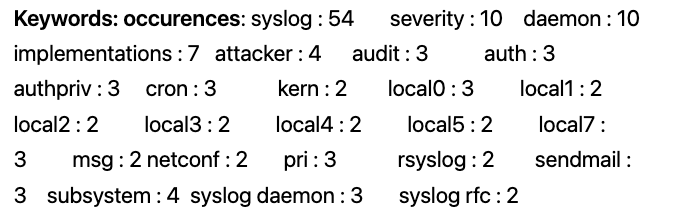
Below is the world’s first AI generated encyclopedia article. References and fact checking are discussed in another post.
Syslog
Syslog is a standard protocol used for sending and receiving system log and event messages in a computer network. It is an integral part of system administration, providing a means to collect, store, and analyze log data from various sources, such as servers, applications, network devices, and security systems. Syslog has become a ubiquitous feature of modern computer systems, and it is supported by most operating systems, network devices, and software applications.
History and Development
The syslog protocol was originally developed at the University of California, Berkeley in the 1980s as a way to centralize and standardize system logging on Unix-based systems. The first version of the protocol, known as syslogd, was released in 1984 and became widely adopted among the Unix community. In the following years, various improvements and extensions were made to the protocol to support new features and technologies.
In 2001, the IETF (Internet Engineering Task Force) published RFC 3164, which defined the standard for the syslog protocol. This version of the protocol is still widely used today and is supported by most devices and software applications that implement syslog.
Functionality and Features
The syslog protocol consists of a client-server architecture, where the client sends log messages to a server, also known as a syslog daemon. The syslog daemon is responsible for receiving and processing log messages, and storing them in a centralized location, such as a log file or a database.
Syslog messages are identified by a priority level, which indicates the severity of the message, and a facility code, which identifies the source of the message. The priority level ranges from 0 (emergency) to 7 (debug), with each level indicating a different level of severity. The facility code identifies the type of system or application that generated the message, and it is used to categorize and filter log messages.
Syslog messages can also include additional information, such as a timestamp, the hostname of the system that generated the message, and a message ID. This information can be used to track and correlate log messages across multiple systems and applications.
Implementation and Usage
Syslog is implemented in a variety of software and hardware devices, including servers, routers, switches, firewalls, and applications. Most Unix-based systems, including Linux and macOS, come with a built-in syslog daemon that can be configured to collect and store log messages.
In addition to the standard syslog protocol, there are several variations and extensions of the protocol that provide additional features and functionality. One such extension is the syslog-ng (syslog next generation) protocol, which adds support for advanced filtering, encryption, and message routing capabilities.
Syslog is a critical component of system administration and security monitoring, providing a means to collect and analyze log data from various sources. It is used in a variety of applications, including network security, compliance auditing, and performance monitoring. Syslog data can be analyzed using various tools and techniques, such as log management software, SIEM (security information and event management) systems, and data analytics platforms.
Conclusion
Syslog is a standard protocol used for system logging and event messaging in computer networks. It has become an essential tool for system administration and security monitoring, providing a means to collect, store, and analyze log data from various sources. The syslog protocol is widely supported by most operating systems, network devices, and software applications, and it is implemented in a variety of hardware and software devices. With its wide adoption and rich functionality, syslog will continue to play a critical role in system administration and security monitoring for years to come.


 The iKNOWit Story
Great stuff. Any chance you need help?
LikeLike